



Always check your product’s artwork instructions. Bleed and safe margins can vary by product.
A0–A7 paper sizes
The A-series is the most commonly used paper size system for printed products. The dimensions refer to the finished, trimmed size of the product.
| Size | Millimetres | Centimetres | Typical use |
|---|---|---|---|
| A0 | 841 × 1189 mm | 84.1 × 118.9 cm | Large posters and display boards |
| A1 | 594 × 841 mm | 59.4 × 84.1 cm | Posters and display boards |
| A2 | 420 × 594 mm | 42.0 × 59.4 cm | Posters and signs |
| A3 | 297 × 420 mm | 29.7 × 42.0 cm | Posters and brochures |
| A4 | 210 × 297 mm | 21.0 × 29.7 cm | Brochures, magazines and documents |
| A5 | 148 × 210 mm | 14.8 × 21.0 cm | Flyers, booklets and programmes |
| A6 | 105 × 148 mm | 10.5 × 14.8 cm | Postcards and flyers |
| A7 | 74 × 105 mm | 7.4 × 10.5 cm | Small cards and coupons |
How do A-series paper sizes work?
When an A-series sheet is cut in half parallel to its shorter side, it becomes the next smaller size. A3 becomes A4, A4 becomes A5 and A5 becomes A6.
The proportions remain the same, making it relatively easy to adapt the same design to different A-series sizes.
Which paper size should you choose?
The right size depends on the amount of content, how the printed product will be used and the distance from which it will normally be viewed.
Flyers, postcards, invitations and other compact printed products that are easy to distribute.
Brochures, magazines, price lists, programmes and smaller posters.
Posters and other display materials that need to be visible from a greater distance.
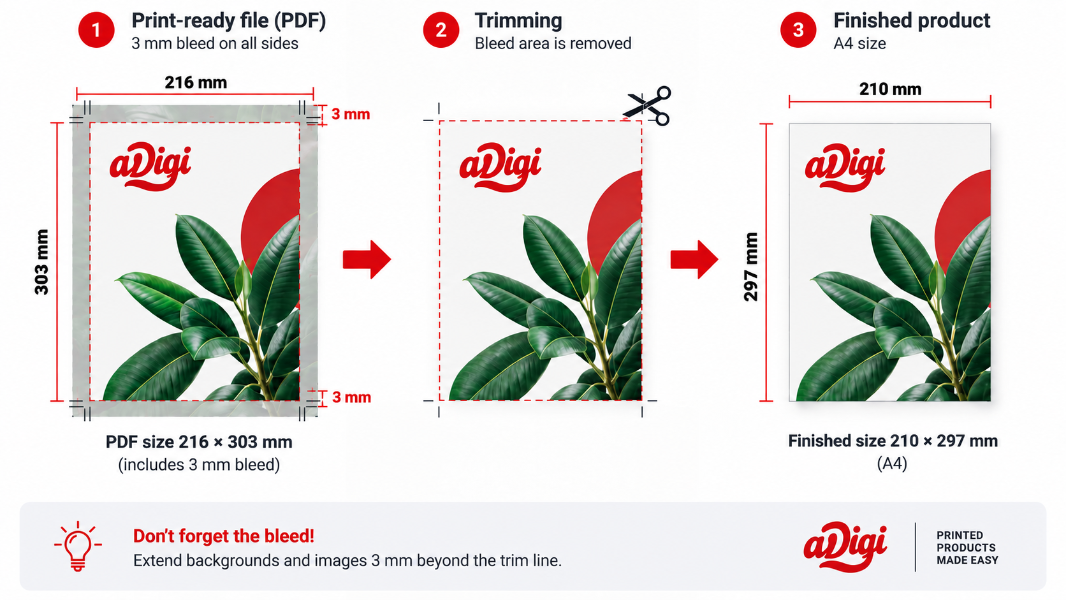
Example: artwork with 3 mm bleed
A paper size such as A4 210 × 297 mm refers to the finished trimmed size.
Extend edge-to-edge backgrounds beyond the trim line by the amount specified for your product. This extra area is called bleed. The example below uses 3 mm.
The finished size of A4 is 210 × 297 mm. With 3 mm bleed added on all sides, the artwork size is 216 × 303 mm.
| Finished size | Trimmed dimensions | Artwork + 3 mm bleed |
|---|---|---|
| A2 | 420 × 594 mm | 426 × 600 mm |
| A3 | 297 × 420 mm | 303 × 426 mm |
| A4 | 210 × 297 mm | 216 × 303 mm |
| A5 | 148 × 210 mm | 154 × 216 mm |
| A6 | 105 × 148 mm | 111 × 154 mm |
| A7 | 74 × 105 mm | 80 × 111 mm |
For large posters and large-format printing, the required bleed may depend on the product and finishing method. Check the product-specific artwork instructions when needed.
Paper sizes in pixels – 300 ppi
Pixel dimensions are useful when artwork is created as a raster image. For printed products viewed at close range, 300 ppi is a good starting point.
| Size | Dimensions | Approx. at 300 ppi |
|---|---|---|
| A0 | 841 × 1189 mm | 9933 × 14043 px |
| A1 | 594 × 841 mm | 7016 × 9933 px |
| A2 | 420 × 594 mm | 4961 × 7016 px |
| A3 | 297 × 420 mm | 3508 × 4961 px |
| A4 | 210 × 297 mm | 2480 × 3508 px |
| A5 | 148 × 210 mm | 1748 × 2480 px |
| A6 | 105 × 148 mm | 1240 × 1748 px |
| A7 | 74 × 105 mm | 874 × 1240 px |
Large posters do not always require 300 ppi
A0 and A1 posters are usually viewed from a greater distance than brochures or cards. For this reason, a lower image resolution can still produce good results at the intended viewing distance.
Other common print sizes
A printed product does not have to use an A-series size. Posters, flyers, brochures and cards are also commonly produced in other standard dimensions.
| Size | Dimensions | Typical use |
|---|---|---|
| B1 | 700 × 1000 mm | Large posters |
| B2 | 500 × 700 mm | Posters |
| DL | 99 × 210 mm | Flyers and brochures |
| Square | 210 × 210 mm | Brochures and programmes |
| Business card | 90 × 50 mm | Common Finnish business card size |
| Postcard | 105 × 148 mm | A6 postcard |
Paper size and paper weight are different things
A4, A5 or A6 describes the physical dimensions of the product. Paper weight, such as 130 g/m², 170 g/m² or 300 g/m², describes the weight of one square metre of the paper – not its size.
The same A5 product can therefore be printed on a lighter paper or on a heavier, more card-like stock.
Brochures, flyers and, for example, inside pages of magazines.
A more substantial option for flyers and brochures.
Cards, covers and products that require a more substantial card-like feel.
Choose the finished size before designing
It is best to design the artwork at the final size from the beginning. Changing the size at the end can affect text proportions, margins and image resolution.
Frequently asked questions about paper sizes
What size is A4 paper?
A4 is 210 × 297 mm, or 21.0 × 29.7 cm. In landscape orientation, the dimensions are 297 × 210 mm.
What size is A5 paper?
A5 is 148 × 210 mm, or 14.8 × 21.0 cm. A5 is obtained by cutting an A4 sheet in half.
What size is A6 paper?
A6 is 105 × 148 mm, or 10.5 × 14.8 cm. It is a common size for postcards and flyers.
How do A-series paper sizes work?
Cutting an A-series sheet in half parallel to its shorter side produces the next smaller size. For example, one A4 sheet becomes two A5 sheets.
How much bleed should I add to print artwork?
Use the bleed specified for your product. For example, A4 artwork with 3 mm bleed on all sides measures 216 × 303 mm.
What are the A4 pixel dimensions at 300 ppi?
A4 is approximately 2480 × 3508 pixels at 300 ppi. Text and vector graphics in a PDF do not need to be converted to raster images.
Can a printed product use a custom size?
Yes. Printed products can also be produced in B sizes, DL format, square formats and many other dimensions. Specify the required finished size in millimetres.
Which paper size is best for a flyer?
A6 and A5 are common flyer sizes. A6 is compact and easy to distribute, while A5 provides more space for images and text.
Which size is suitable for a poster?
A3 works well for smaller posters. A2, A1 and A0 provide greater visibility. B2 500 × 700 mm and B1 700 × 1000 mm are also common poster sizes.
Your printed product does not have to be A4 or A5. Tell us the required finished size, quantity and intended use, and we can suggest a suitable production method and material.